How to Calculate the Actual Width of a Road Cross Section

How to Calculate the Actual Width of a Road Cross Section (With Example)

Designing a road cross-section is one of the  important steps in highway engineering. to Understanding how to calculate the actual width of a road including side slopes is most important.

In this article, we’ll go through a simple and clear method to determine the actual total width of a road cross-section, step by step with an example

What is a Road Cross Section?

A road cross section represents a vertical cut through the road, showing different layers, slopes, and dimensions such as:

  • Top width (carriageway)

  • Side slopes or embankments

  • Road shoulders and ditches

This helps to determine earthwork quantities, drainage levels, and stability of slopes.

As Shown the image

  • Road top width = 6 m

  • Left side height = 2 m

  • Right side height = 2 m

  • Side slopes = 1 : 3 (1 vertical → 3 horizontal)
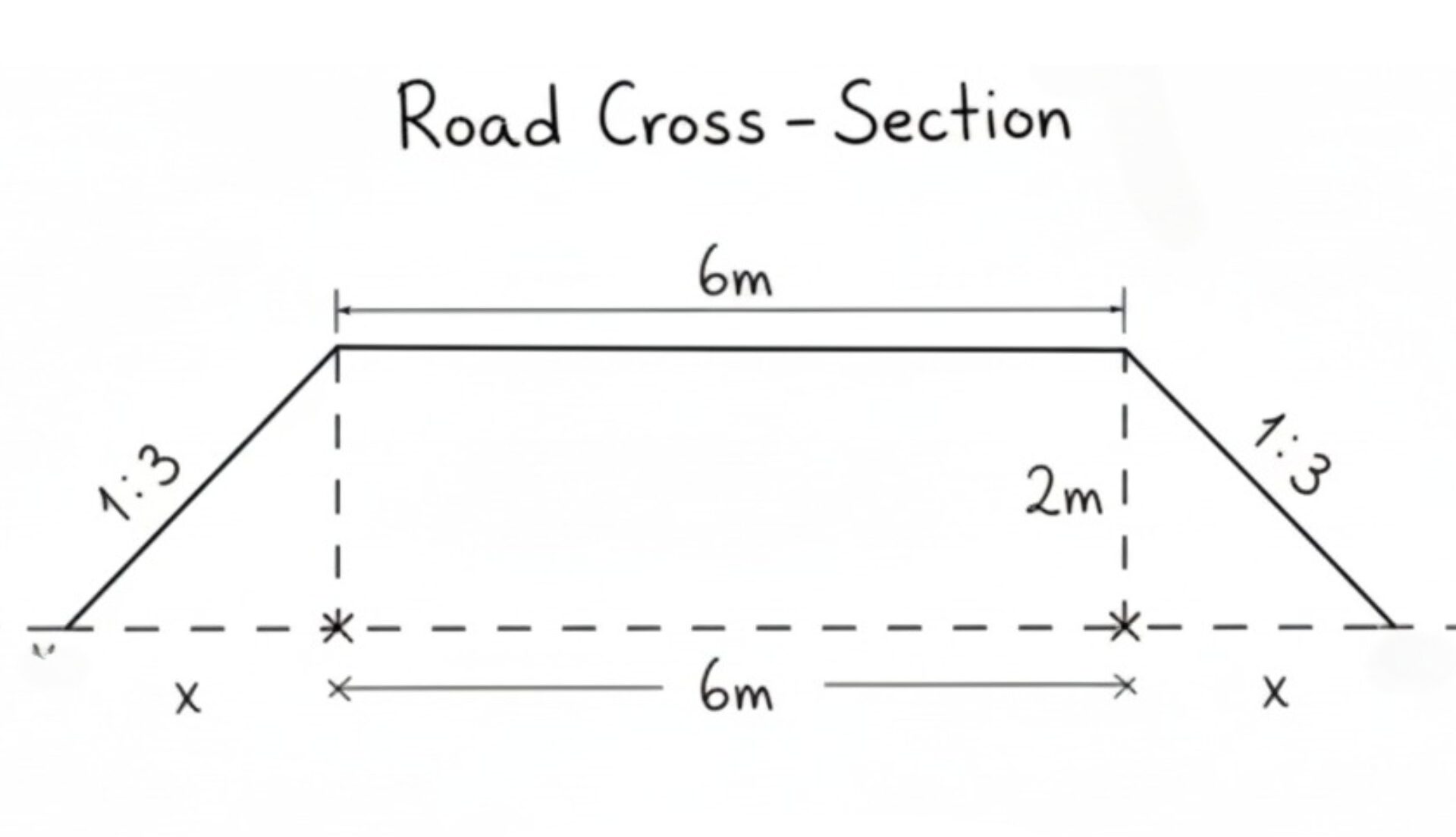
Step 1: Calculate Horizontal Distance for Each Slope

Left  & Right Side:

Vertical height= 2 m
Given Slope = 1 : 3
 Actual Horizontal Distance = x  
So, 

Horizontal Slope          =        Actual vertical slope   
Horizontal Distance        Actual Horizontal Distance (x) 

1 / 3 = 2 / x 

x * 1 = 3 * 2 , x = 6m 

Each side extends 6 meters horizontally from the edge of the carriageway

Step 2: Calculate the Total Road Width

Total Width = “x” left+ Formation Width + “x” right

So Total Width = 6 + 6 + 6 = ​18 m 

✅ Therefore, the actual total width of the road cross section is 18 meters.

Why This Calculation Is Important

Accurately calculating the road cross-section width is important for:

  •  Estimating earthwork quantities (cutting and filling)

  •  Preparing BOQ (Bill of Quantities)

  •  Cost estimation and resource planning

  •  Ensuring proper drainage design and slope stability

How Many Boxes Are There? – A 3D Visualization Puzzle for Engineers

Being able to visualize 3D objects from 2D drawings is one of the most valuable skills for anyone working in construction, architecture, or engineering. Whether you are reading plans, checking site layouts, or interpreting material drawings, understanding side, back, and top views is extremely important.

The Puzzle: Count the Total Number of Boxes

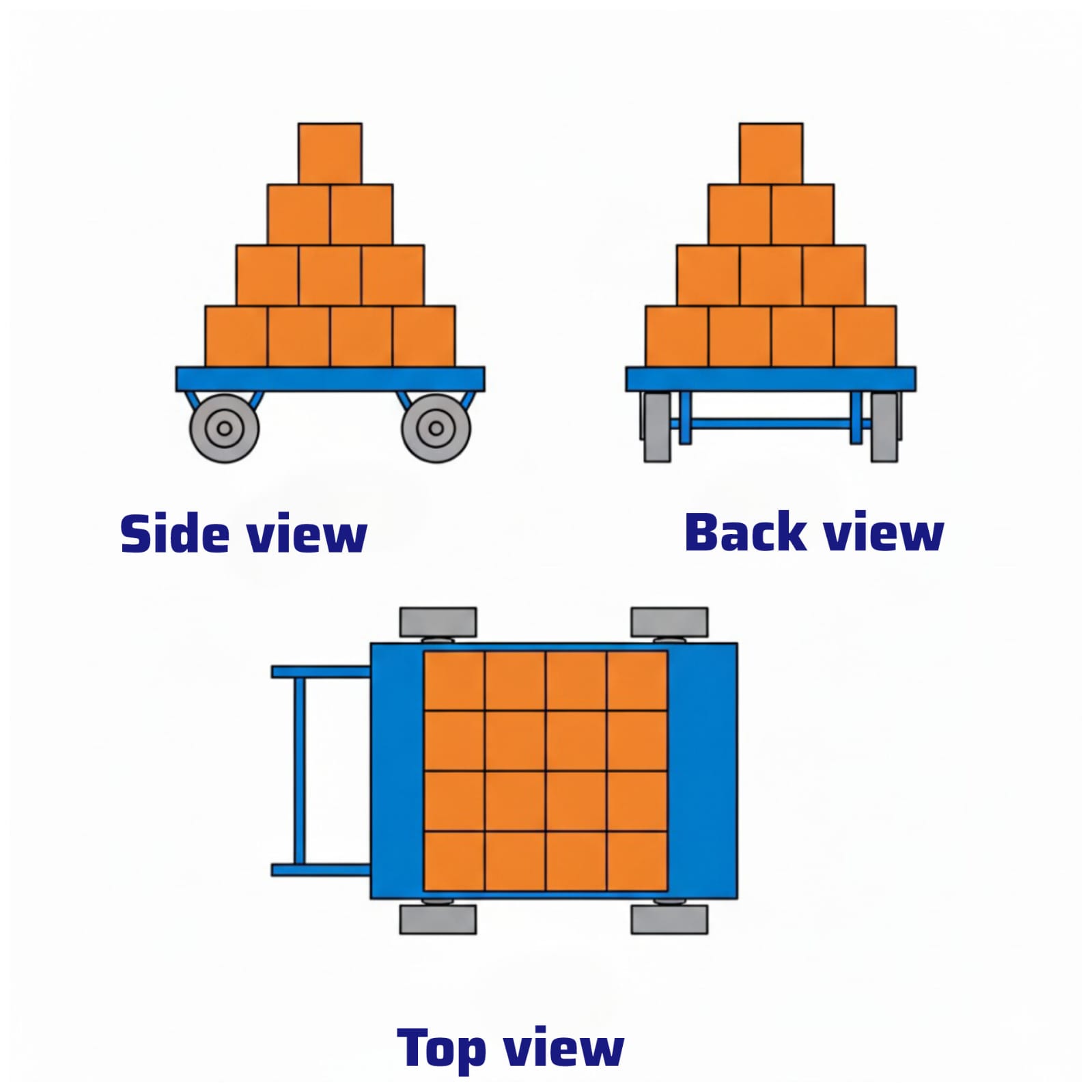
Look at the three views of the vehicle loaded with boxes:

  • Top View – shows how the boxes are arranged from above.

  • Side View – shows how the structure looks from one side.

  • Back View – shows how it looks from behind.

Your task: Analyze all three views and calculate the total number of boxes stacked on the trolley.

Step-by-Step Solution

Let’s solve it by counting the number of boxes layer by layer:

  • 1st layer (bottom): 4 × 4 = 16 boxes

  • 2nd layer: 3 × 3 = 9 boxes

  • 3rd layer: 2 × 2 = 4 boxes

  • Top layer: 1 × 1 = 1 box

Total Number of Boxes

Now, add them all together:

Total = 16 + 9 + 4 + 1 = 30 boxes

Answer: 30 boxes

This simple puzzle is a great example of how combining information from top, side, and back views can help you reconstruct a 3D object — a skill that’s essential in construction and engineering.

What is 3-4-5 Method in Construction? How to Ensure Perfect 90° Angles in Foundation Layout

When starting any building project, accuracy in the foundation layout is important. One of the most common mistakes on site is misaligned corners due to incorrect angle marking. Even a small error in angle can cause walls to go out of alignment, leading to structural problems.

To avoid these kinds of mistakes, we should use the following rule: the simplest and most effective method to achieve perfect 90° corners on-site is by applying the 3-4-5 Rule, which is based on the Pythagorean theorem.

What is the 3-4-5 Method?

The 3-4-5 Method is a simple site technique used to form a right angle (90°) by measuring three sides of a triangle in the ratio 3:4:5.
This ratio is derived from the Pythagoras theorem,

which states: a² + b² = c²

Where:

  • ‘a’ and ‘b’ = sides that meet at 90°
  • ‘c’ = hypotenuse (diagonal side)

If a triangle’s sides follow this 3 : 4 : 5 ratio, the angle opposite the hypotenuse is exactly 90°.

Let’s find out using this method with actual measurements:

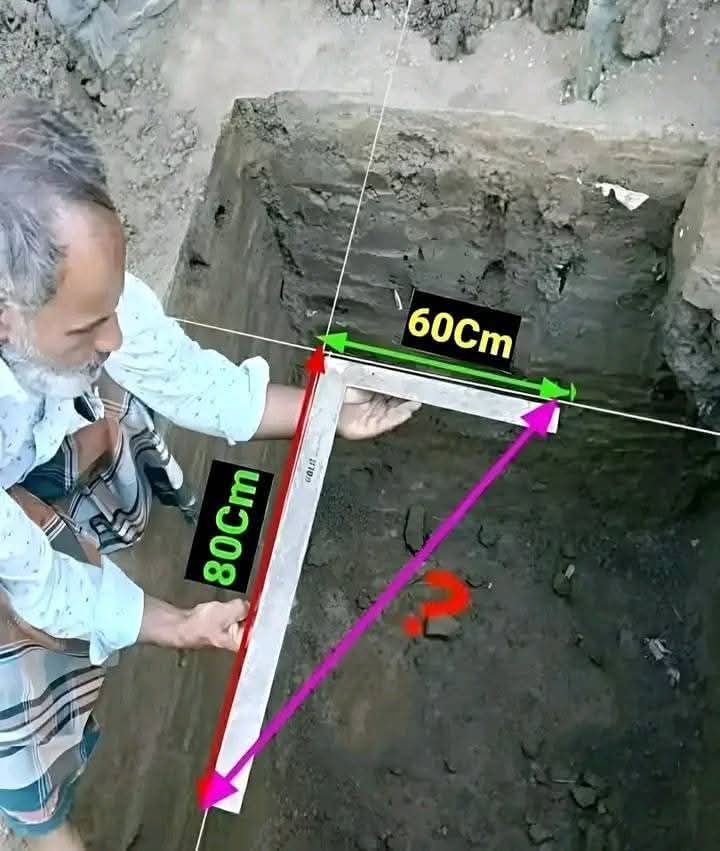
Example Calculation From the image
Measure along one side: a = 60 cm
Measure along the other side: b = 80 cm
Measure the diagonal distance (c) between these two points

so c²= 60² + 80² = 10000
c = √10000 = 100

This confirms that the diagonal (c) should be 100 cm.
If these three sides are marked correctly on site, the angle formed between sides a and b will be a perfect 90°.

How to Apply the 3-4-5 Method on Site

  • You can scale the ratio for larger dimensions. For example, using a scale factor of 20 cm:
  • 3 × 20 cm = 60 cm
  • 4 × 20 cm = 80 cm
  • 5 × 20 cm = 100 cm
  • If the diagonal measures 100 cm, the angle is a perfect right angle.

Why is the 3-4-5 Method Used in Construction?

The 3-4-5 rule is widely used on site because it is:

  • Simple and practical: No need for complex instruments or calculations.
  • Accurate: Make sure tha walls, footings, and foundations are laid out at true 90° angles.
  • Time-saving: Quick to apply with just a tape measure and string.
  • Works for small buildings, boundary walls, and large construction projects.

Accurate right angles are essential for:

  • Setting out foundations
  • Aligning walls and columns
  • Ensuring formwork is square
  • Avoiding structural errors and rework

How to Calculate the Slanted Side of a Trapezoid

In construction and civil engineering & any other areas, we often deal with irregular shapes while preparing drawings or taking site measurements etc. One such common case is when a rectangular area is trimmed by a diagonal cut, creating a slanted side.
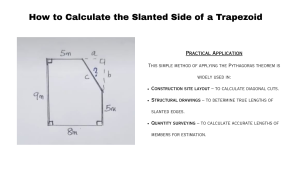
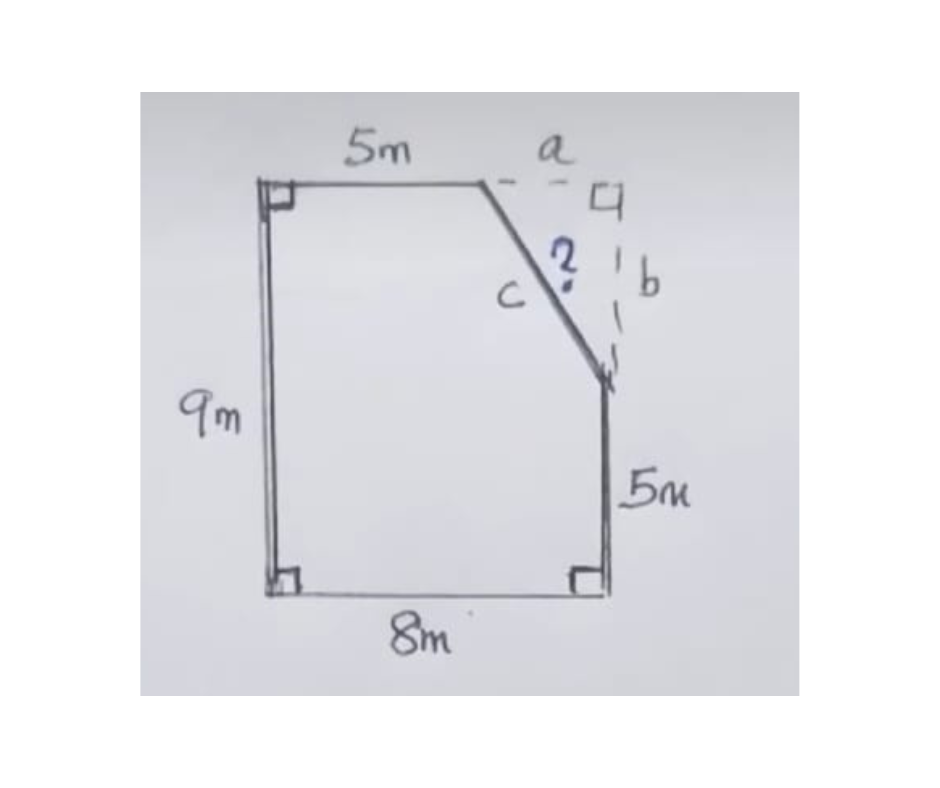
In this article, we will find it out how to calculate the slanted side of the figure shown the image


Given Dimensions From the image

  • Left vertical side = 9 m
  • Bottom horizontal side = 8 m
  • Top horizontal side = 5 m
  • Right vertical side (below chamfer) = 5 m
  • Slanted side = c (to be calculated)

The figure can be visualized as a rectangle where the top-right corner is cut off by a diagonal line.


Step 1: Identify the right-angled triangle

From the image:

Bottom Horizontal length is 8m & Top Horizontal length is 5m
So, a = 8 – 5 = 3 m

Left Vertical side is 9m & Right Vertical Side is 5m
So. b = 9 -5 = 4m

This forms a right-angled triangle with:

  • a = 3m
  • b = 4m
  • Hypotenuse = c (the slanted side we need).

Step 2: Apply Pythagoras Theorem

The Pythagoras theorem states:

a² + b² = c²

3² + 4² = c² , c² = 9+ 16 ,

c² = 25, c = √25

c = 5 m, The length of the slanted side is: c = 5m ​


Practical Application

This simple method of applying the Pythagoras theorem is widely used in:

  • Construction site layout – to calculate diagonal cuts.
  • Structural drawings – to determine true lengths of slanted edges.
  • Quantity surveying – to calculate accurate lengths of members for estimation.

Solve This Tricky Math Puzzle: Can You Find the Missing Number

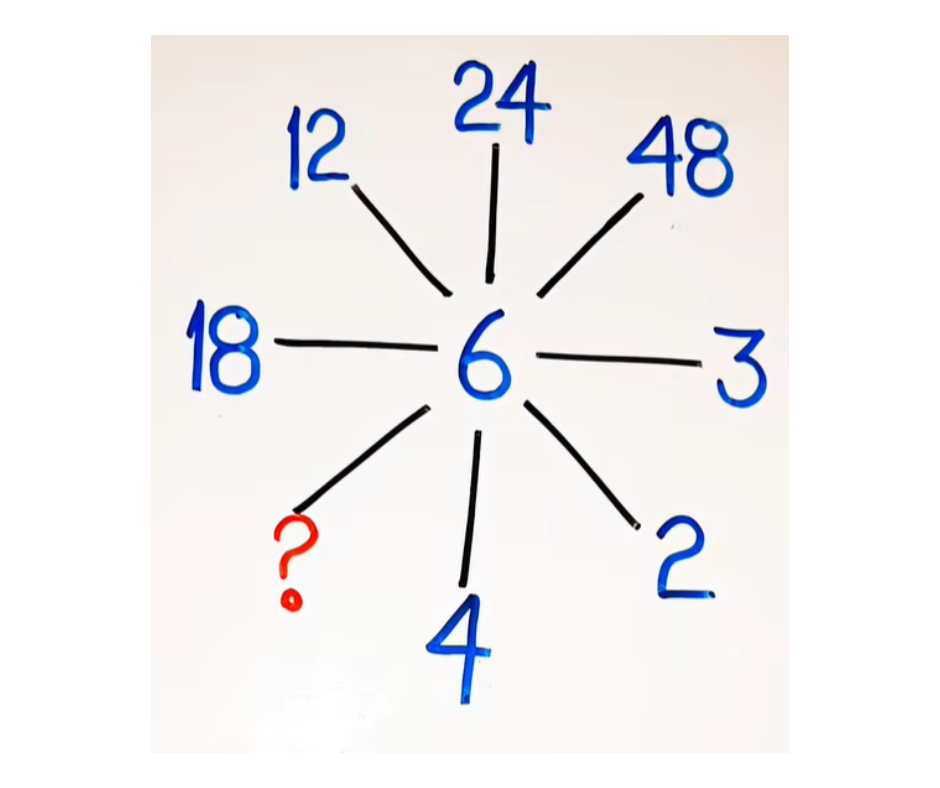
This puzzle challenges you to find the missing number in the circle. At the center, you’ll see the number 6, and around it, different numbers like 12, 24, 48, 3, 2, 4, 18, and one missing value marked with a question mark.

👉 The rule is simple: each outer number is connected to the center number 6 through multiplication or division.

Now, what about the missing number?
Following the same pattern, the missing value

  • 4 x 6 = 24 ✅ (or) 24 ÷ 6 = 4 ✅
  • 2 x 6 = 12 ✅ (or) 12÷ 6 = 2 ✅
  • 3 x 6 = 18 ✅ (or) 18 ÷ 6 = 3 ✅
  • ? x 6 =48 (or) 48 ÷ 6 = ?

So, The missing Number 48 ÷ 6 = 8, So 8 x 6 = 48

Final Answer:8

This puzzle is a great way to sharpen your logical thinking and practice multiplication and division in a fun way. Share it with your friends and see if they can solve it faster than you!

Solve this Equations (Math Puzzle)

Solve These Equations: A Fun Math Puzzle to Challenge Your Brain

Mathematics is not just about numbers and formulas; it’s also a playground for your mind!

Solve the following equations:

  1. Y + 2 = -Y

  2.  3X – 5 = 10 

  3. 7P 4 = 3P + 8

Take your time and think carefully. These equations might look simple, but they’re excellent exercises for sharpening your mind.

1️⃣ Solve  Y + 2 = -Y

So, Step 1     Y + Y = – 2

Step 2     2Y = -2 

Answer: Y = -2 /2  = -1 

2️⃣ Solve  3 X – 5 = 10

So, Step 1     3 X = 10 + 5 

                       3 X = 15

Step 2             X = 15 / 3  

Answer: X = 5 

3️⃣ Solve  7P 4 = 3P + 8

So, Step 1     7P – 4 + 3P = 8

                          10P – 4 = 8

Step 2               10P  = 8 +4 

                            10P  = 12 

Answer:  P = 12 / 10 = 1.2 


How Many Squares Can You Count? Test Your Visual Skills!

Mind Puzzle Test your brain with this fun picture puzzle!
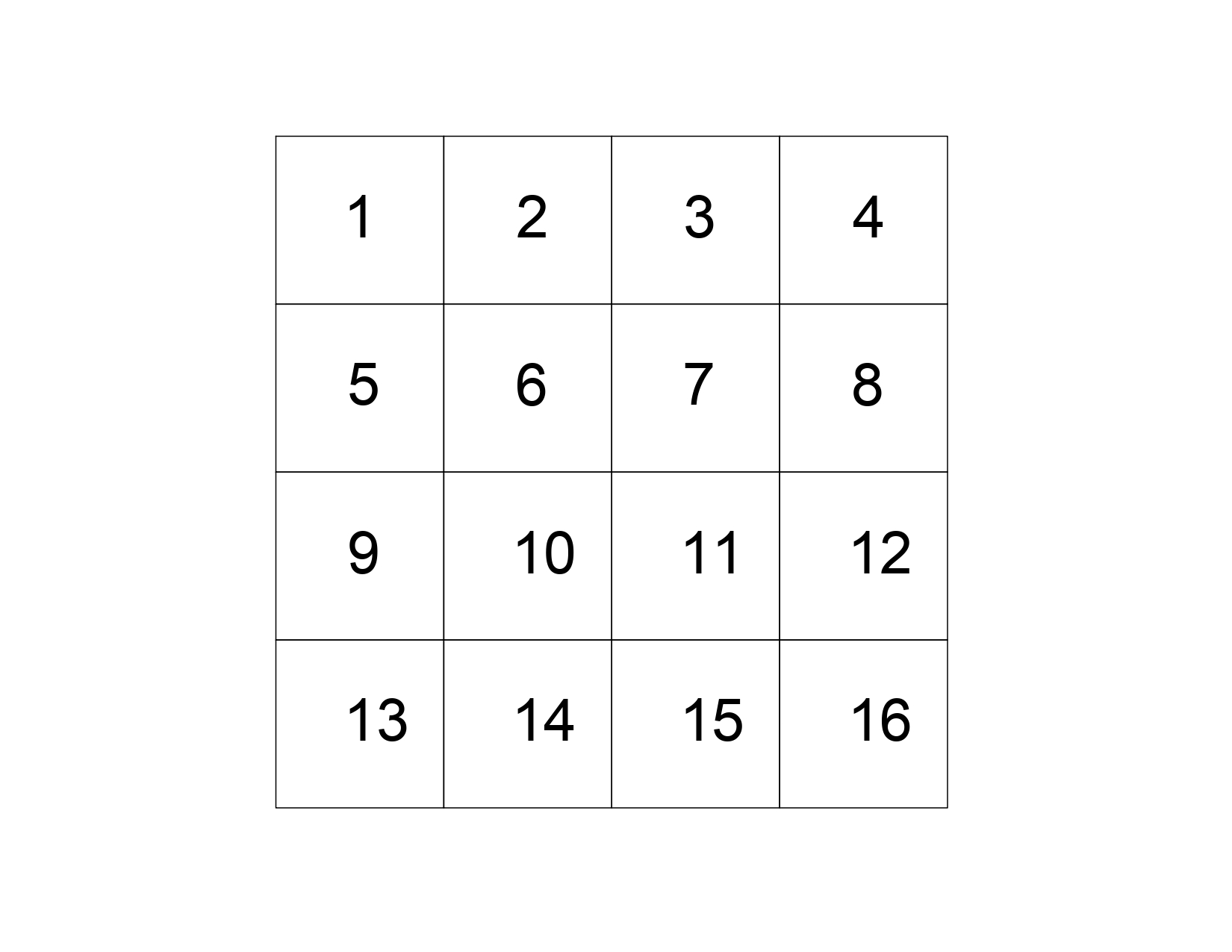
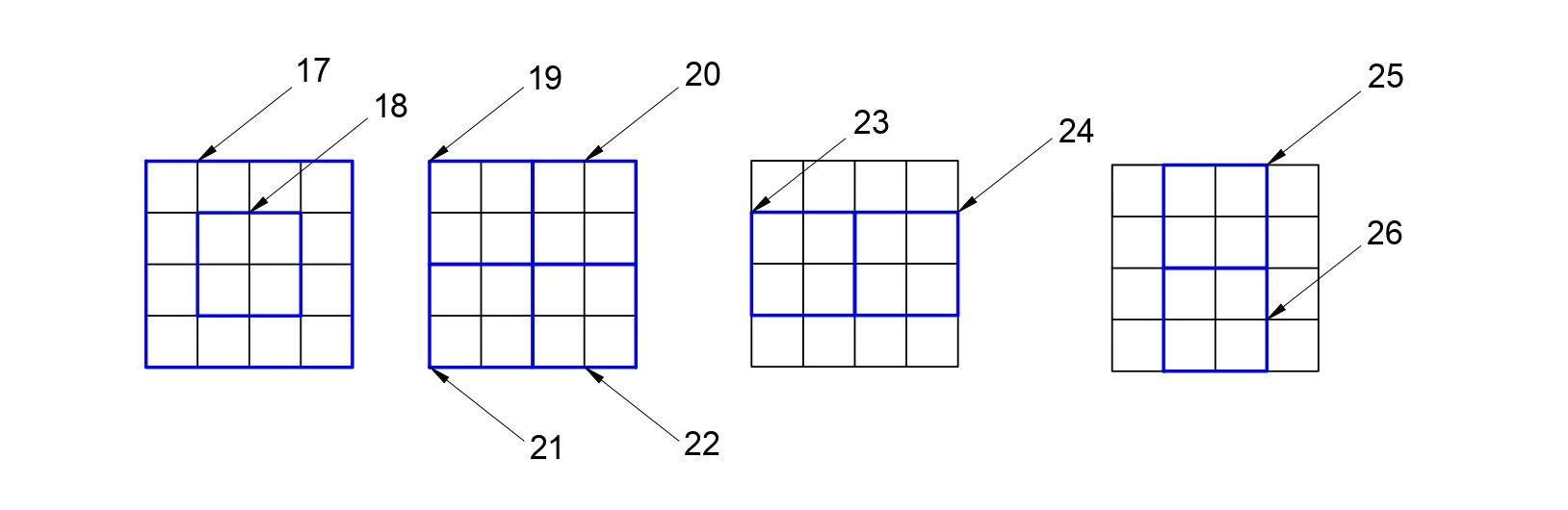
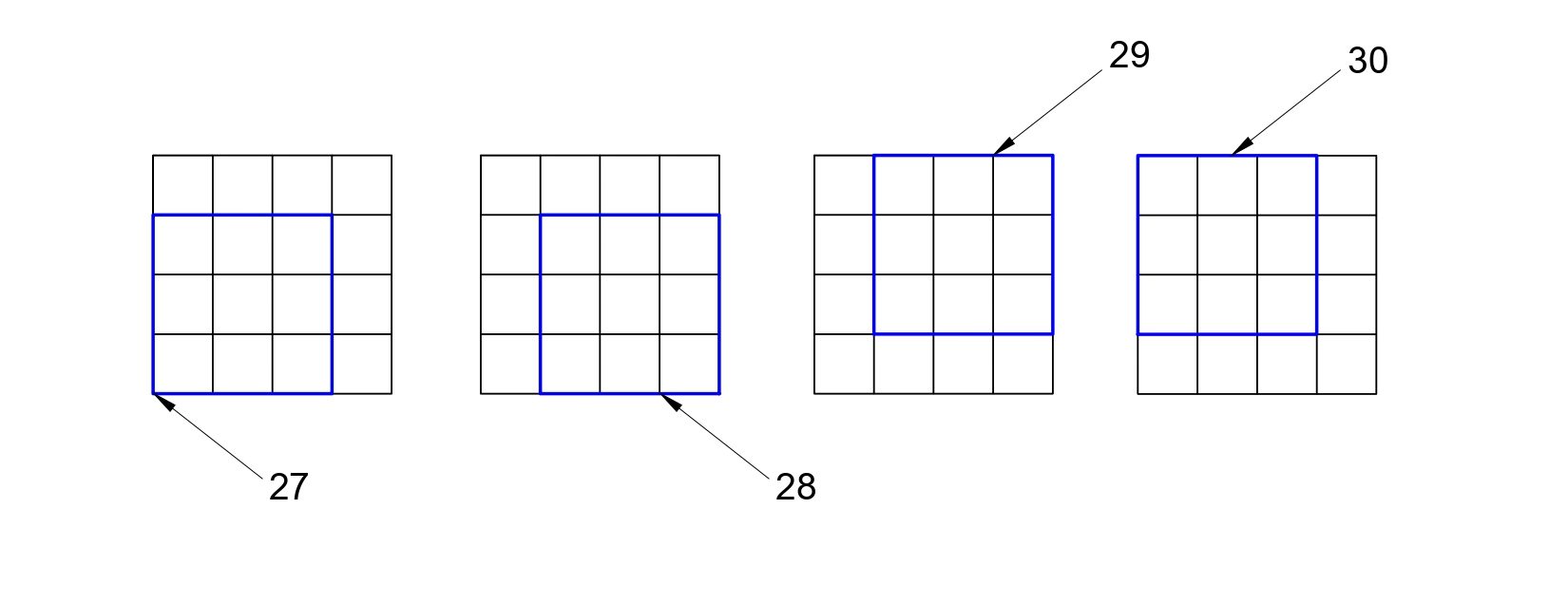
The image above has a grid made of lines that create many squares. Can you count how many squares are hidden inside it?
This fun activity helps you improve your attention and thinking skills.
Write your answer in the comments and check if others think the same! Lets calculate

Basic 1×1 Squares (Smallest)

These are the smallest individual squares.

There are 16 squares (4 rows × 4 columns).

The entire grid is one big 4×4 square, which is number-17

Each 2×2 group of small squares forms a bigger square.-18 to 26

You can form 9 squares of this size.

3×3 Squares

  • Each 3×3 block inside the grid also forms a square.
  • You can find 4 squares of this type.
  • Total squares counted = 30

Can you spot all 30 squares?
This puzzle is a great way to boost your attention and observation.
Write your answer in the comments and compare with others!

Move One Stick and Make Equation is Correct

This Matchstick puzzles are trending on internet now lets solve this puzzle

Matchstick Puzzle – Solve the Equation by Moving One Stick!

Look at the puzzle in the picture:
7 – 8 = 9 ❌ This is wrong because 7 minus 8 is -1, not 9.

Now, Move only one stick to make the equation correct.

Now lets solve this puzzle
Take the top stick from the number 7. Now the 7 becomes 1.
Put that stick on the minus sign (-) to turn it into a plus sign (+).

Now the new equation is:
1 + 8 = 9


Look at this second puzzle in the picture:
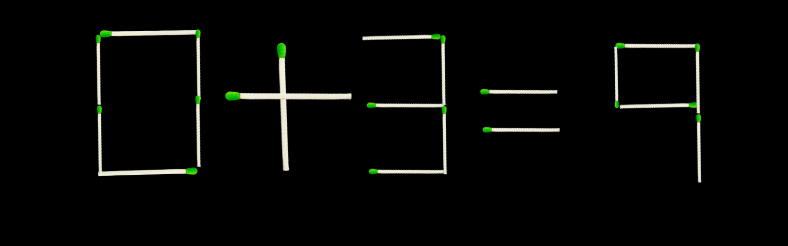
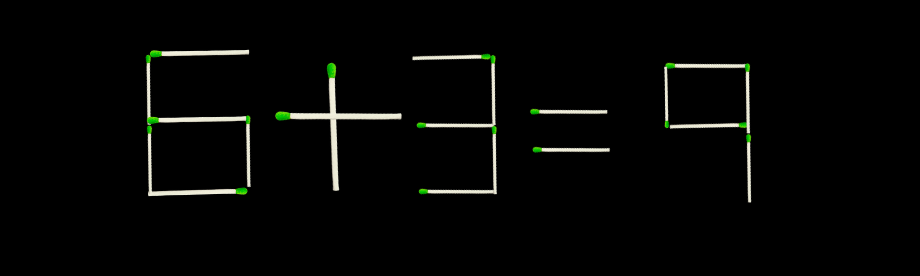
0 + 3 = 9 ❌ This is wrong because 0 + 3 is 3, not 9.

Now lets solve this puzzle
Take the left vertical stick from the number 0. Now, the 0 becomes a 6.

Now the new equation is:
6+3= 9

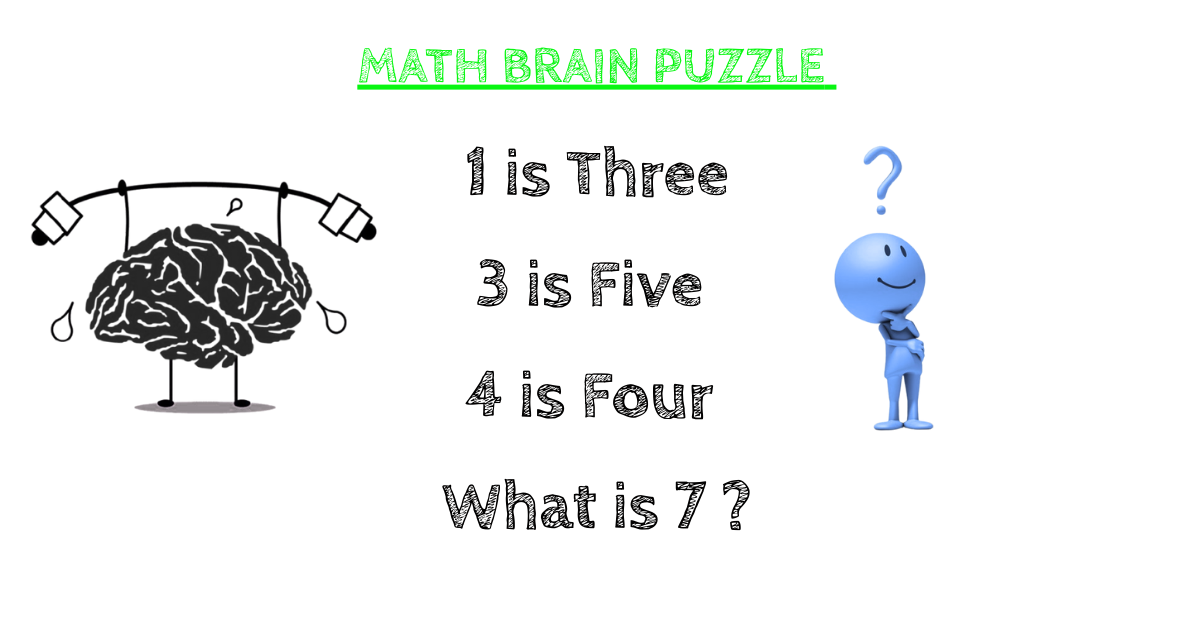
Math Riddle Time! What Is 7?

If you see this puzzle doesn’t make any sense. How can 1 be Three or 3 be Five? It looks like completely illogical, right?

But here’s the trick:
Always think in a different way. Look beyond the numbers!

Here is the Question

  • 1 is Three
  • 3 is Five
  • 4 is Four
  • What is 7?

How can 1 be ‘Three’?
If you write the number 1 in words, it becomes 1 = One, which has three letters.
Therefore, 1 is ‘Three’ is correct.

How can 3 be ‘Five’?
If you write the number 3 in words, it becomes 3 = Three, which has five letters.
Therefore, 3 is ‘Five’ is correct.

How can 4 be ‘Four’?
If you write the number 4 in words, it becomes 4 = Four, which has four letters.
Therefore, 4 is ‘Four’ is correct.

What is 7?
If you write the number 7 in words, it becomes 7 = Seven, which has five letters.
✅ So, 7 is ‘Five’

Draw One Line & Make the Equation Correct

Draw One Line & Make the Equation Correct

This is a fun mind puzzle that makes you think in an alternative and creative way

Look at the equation: 5 + 5 + 5 = 550

This looks wrong. If you add 5 + 5 + 5, the answer is 15, not 550.

So how can we make this correct?

Here’s the Solution: you are allowed to draw just one straight line to fix the equation. You don’t need to erase anything or move numbers around—just one smart line.

The Solution:

Draw a small line on the first + sign to turn it into a 4. Now the equation looks like this:

545 + 5 = 550 And that’s correct!

This puzzle helps how thinking differently can get to the creative solutions. It’s a fun way to improve your brain and your problem-solving skills.

Find the Answer ? Solve this Math’s Puzzle

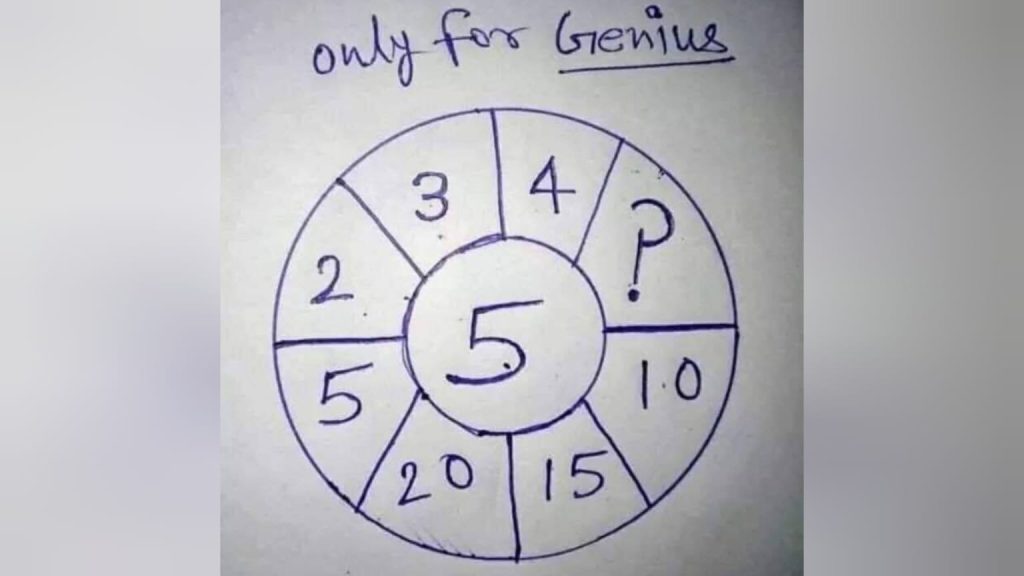
Here is one math puzzle brain-teasing question that recently went viral on social medias “Can You Solve This Math’s Puzzle – Only for Genius Math Problem Answer”. Let’s break it down and solve it step-by-step!

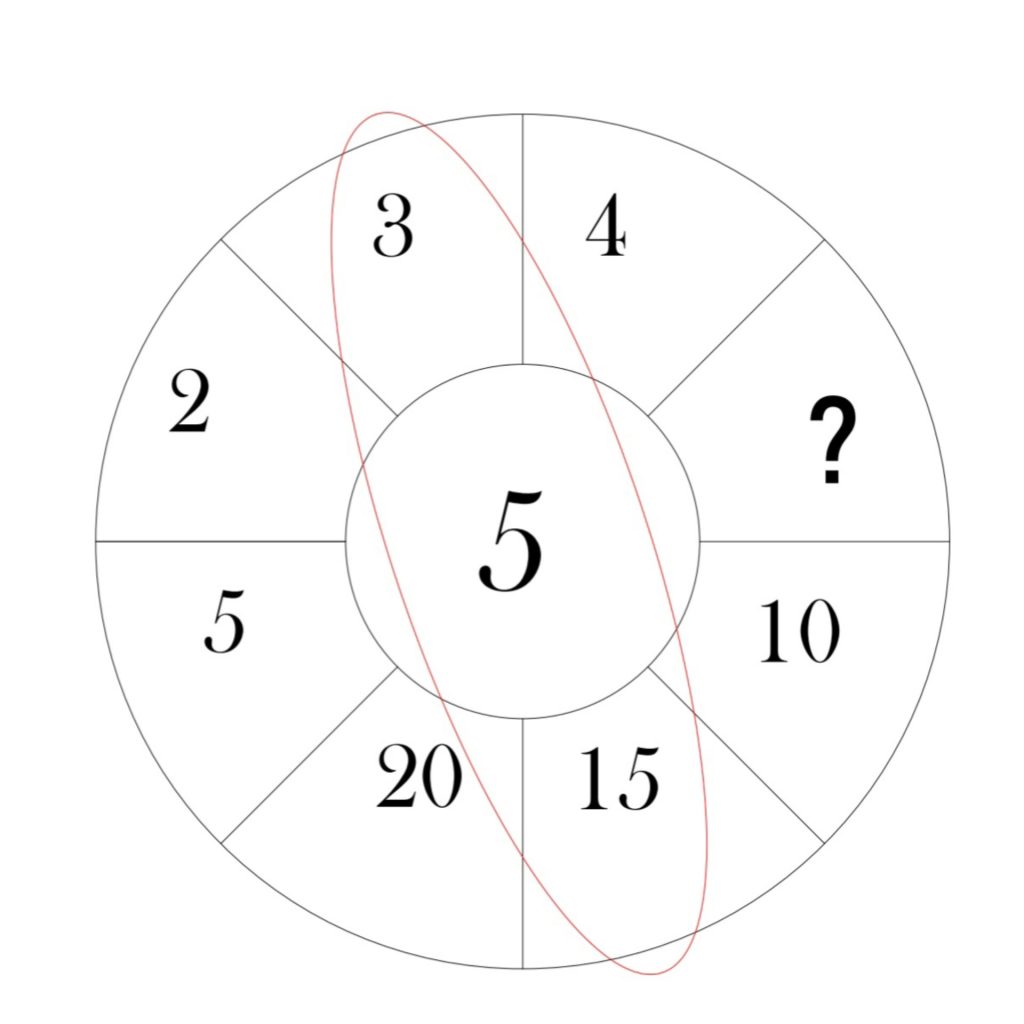
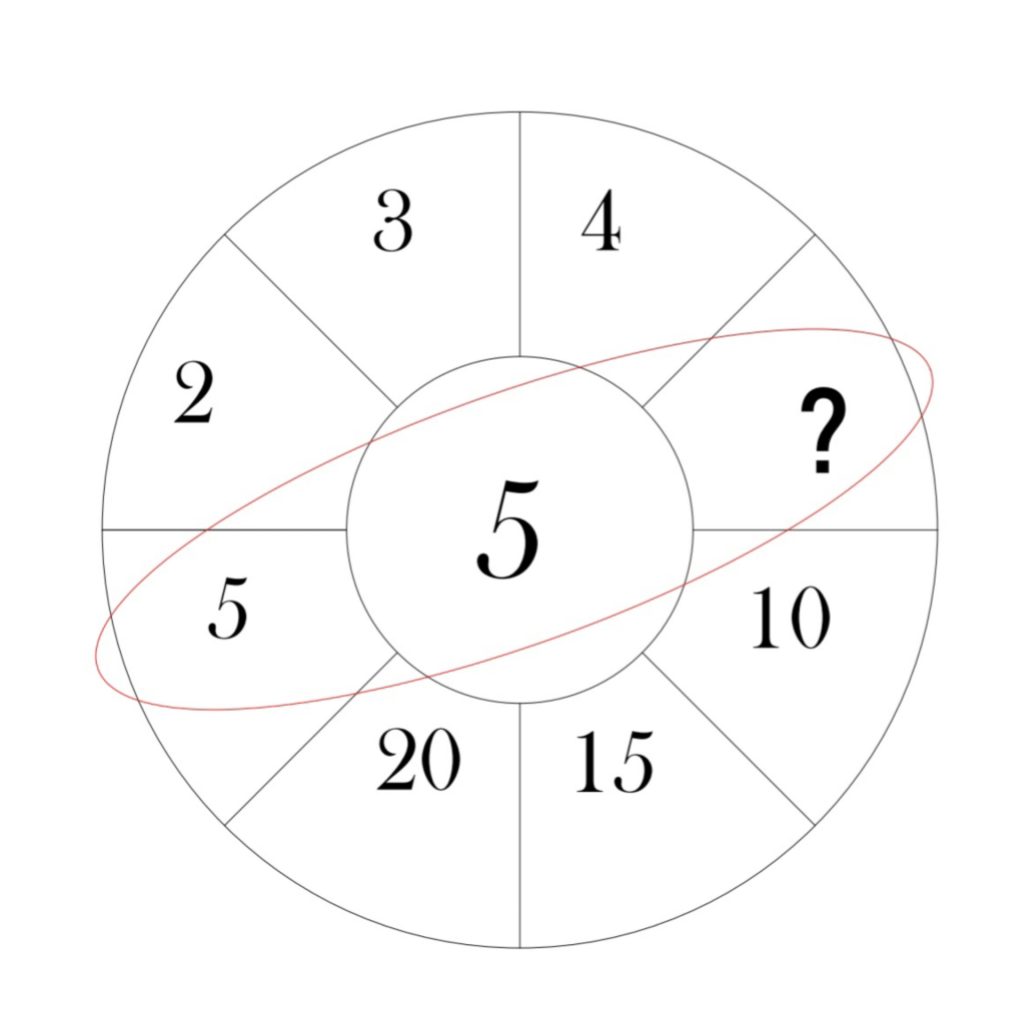
From this puzzle, the number 5 is placed at the center inner circle , and the outer circle is surrounded by numbers like 2, 3, 4, ?, 10, 15, 20, and 5.

🧠 Let’s Find the Answer

This puzzle follows a simple pattern:

From the top, the outer circle numbers are multiplied by the center number (5).

From the bottom, the outer circle numbers are divided by the center number (5).

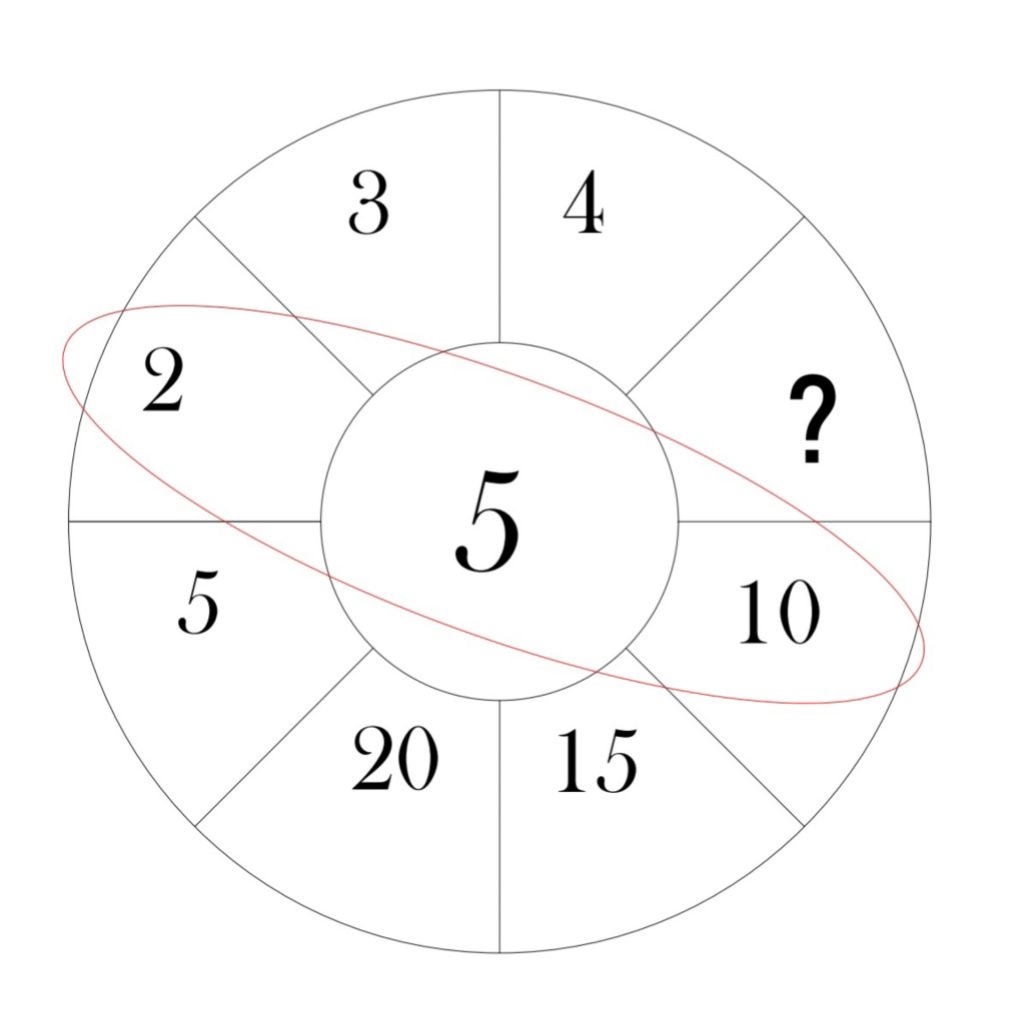
For Example from below image

So, if you look at the top side, the number 2 is multiplied by 5, which gives:

2 × 5 = 10

On the bottom side, it’s the reverse. The number 10 is divided by 5, which also gives:

10 ÷ 5 = 2

Same like above
3 × 5 = 15

From Bottom

15 ÷ 5 = 3

Same like above
4 × 5 = 20

From Bottom

20 ÷ 5 = 4

So Here is The Answer is
5 x 5 = 25

From Bottom

25 ÷ 5 = 5

So, the final missing number is 25.
However, there’s also a possibility that the answer could be 1.
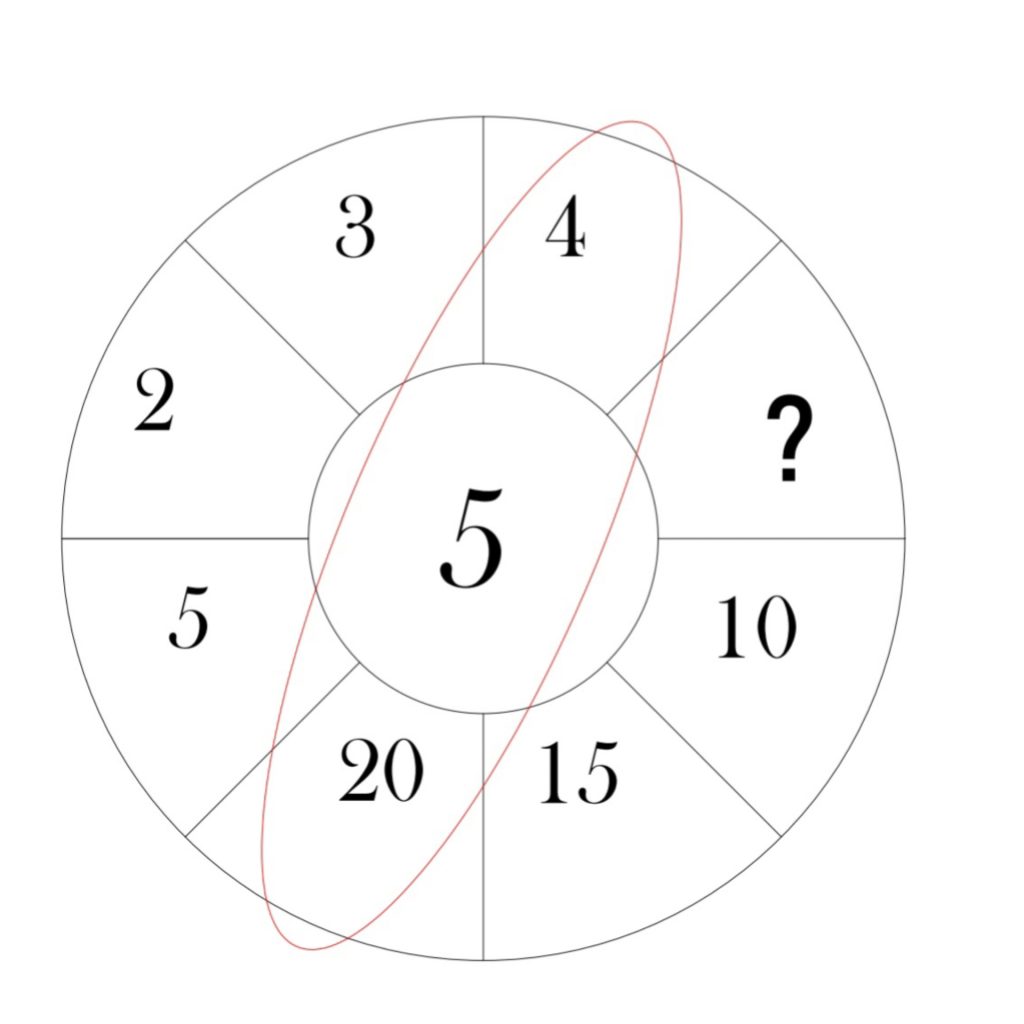
Here’s why:
5 ÷ 5 = 1
And on the other hand, 5 × 1 = 5

Exit mobile version